info@lamalcontentaeillupo.com
© La Malcontenta e Il Lupo
Design and Photo by Zuzù

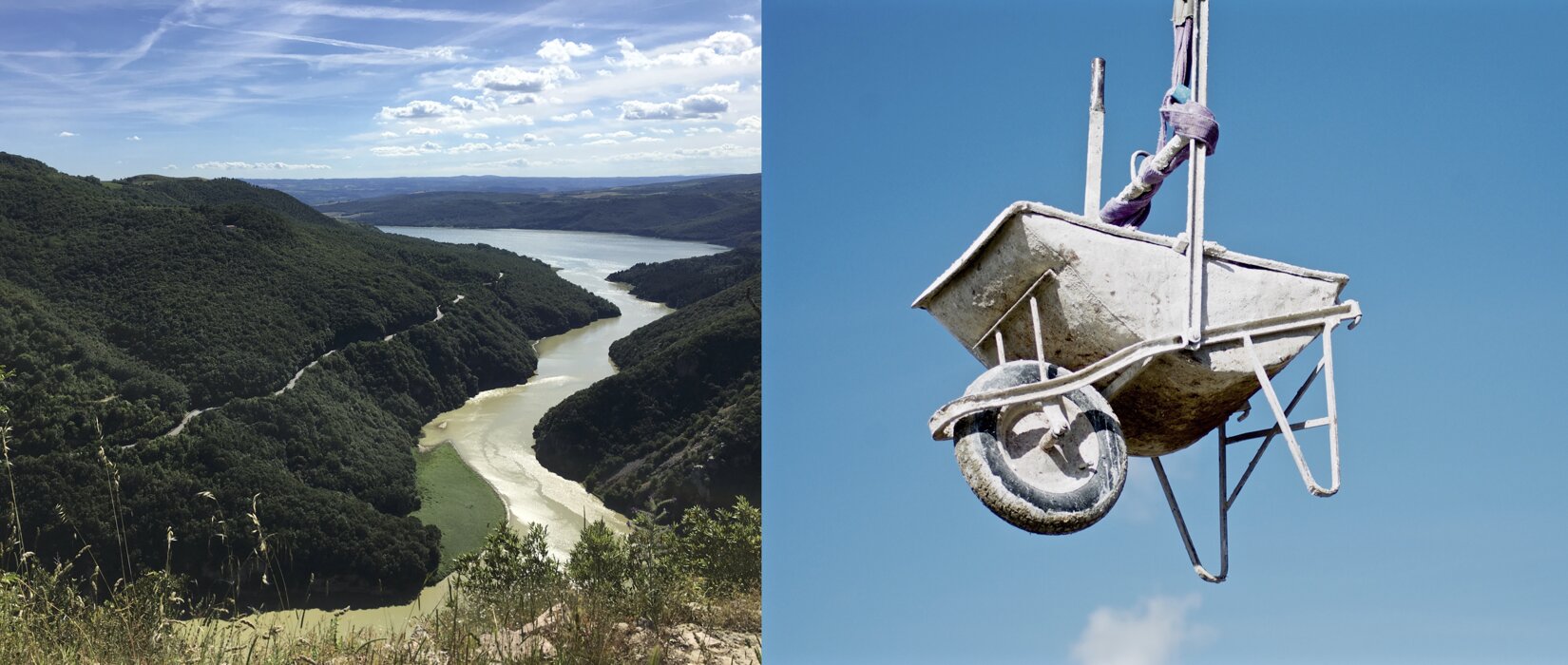

OASIS IN THE CITY
THE 2 WWF OASES IN UMBRIA
- LA MALCONTENTA AND IL LUPO E ALVIANO -
speak through art and green building
URBAN NATURE 2025
OASIS IN THE CITY - TODI - 5 OCTOBER 2025
THE 2 UMBRIAN WWF OASES - LA MALCONTENTA AND IL LUPO AND ALVIANO - speak through art and green building
The national WWF event will be held on October 5, 2025 and on this occasion, in Todi, there will be discussions about nature in urbanized contexts, bringing nature into the city through video works.
The installation of a video art piece created within the WWF Oasis La Malcontenta e il Lupo and the Oasis of Alviano will be presented in Todi.
The artists Auro and Celso Ceccobelli will exhibit video art inspired by nature and created within the two Umbrian WWF Oases, as well as in other valuable natural contexts, inside municipal spaces.
Art, made of images and sound, will tell the story of the natural environment of the Oases, one of those high-biodiversity contexts that Umbria offers us.
Art and nature come together to talk about the environment in a city like Todi, famous for being rich in national and international artists and surrounded by a unique natural heritage.
There will also be a conference on the topic of green building and on the theme of integration between urban and natural environments.
There will be discussions about sustainable building, energy self-sufficiency, innovative construction techniques such as those involving the use of lime and hemp, as well as earth and straw.
Speakers:
Eng. Luca Sonno, expert in energy efficiency
Well-being in building
Eng. Veronica Angelozzi, head of the Calcecanapa line at La Banca della Calce in Bologna
Living in nature: lime and hemp for sustainable building
Sanni Mezzasoma, head of Terra e Paglia
Building sustainably
The meeting will be moderated by Rita Boini, journalist
The work by AURO & CELSO CECCOBELLI, “NATURA ILLUMINATA”,
will be on display all day from 09:30 to 19:30 at the Sala ex Monte dei Paschi di Siena in Piazza del Popolo.
The conference on SUSTAINABLE BUILDING will be held in the Sala Vetrata in Piazza del Popolo in Todi, from 11:00 am to 1:00 pm.
The initiative is patronized by the Municipality of Todi and the Tiber River Park.
For information: info@lamalcontentaeillupo.com
WHO IT IS FOR
The event is open to everyone.
Both events are free and open access.
HIGHLIGHTED
- When: October 5, 2025, from 09:00 to 19:30.
- Where: Todi, Sala ex Monte dei Paschi di Siena and Sala Vetrata, Piazza del Popolo.
- Free event.
Oasis La Malcontenta and the Wolf
The WWF Oasis La Malcontenta e il Lupo is located in Umbria, in the municipality of Todi (PG), near the Tiber River Park and is mainly involved in scientific research, species conservation, and genetic diversity.
The Oasis is a protected area that includes various habitats of naturalistic value, featuring very diverse environments rich in biodiversity: typical wetland areas, naturally evolving forests, phenomena of climatic inversion, and ecosystems that host flora and fauna of considerable interest, including the abundant presence of wild orchids.
Alviano Lake Oasis
The WWF Oasis of Lake Alviano includes all the typical environments of freshwater wetlands: marsh, pond, swamps, hygrophilous forest, and with its 900 hectares it is one of the most important wetlands in central Italy. The Oasis is located within a Special Area of Conservation (IT5220011) in the municipalities of Guardea, Alviano, Montecchio, Civitella d’Agliano (TR). It is also a Special Protection Area (SPA IT5220024).
Tiber River Park
The Tiber River Park extends for about 7,925 hectares in the municipalities of Monte Castello di Vibio, Todi, Baschi, Orvieto, Montecchio, Guardea, and Alviano. In addition to the river course and the artificial lakes of Corbara and Alviano, it includes the hill of Todi, the Pasquarella Valley, the hilly slope between Titignano and Prodo, and part of the area around Civitella del Lago. The minimum altitude is 68 meters at Lake Alviano, the maximum is 548 meters on the hills of Prodo. (from "Ecomanuale Parco regionale del Fiume Tevere")
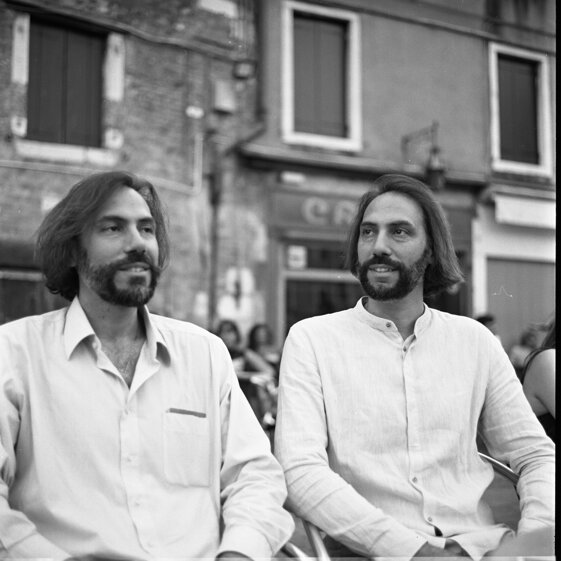
AURO & CELSO CECCOBELLI
CelsAuri
The twins Auro and Celso Ceccobelli (Rome, May 12, 1986) work in the field of contemporary art creating performative sculptures, art videos, and Raku ceramics. They are the sons of the symbolist painter-sculptor Bruno Ceccobelli (1952), grandsons of the informal sculptor Toni Fabris (1915-1989), and great-grandsons of the porcelain artist Luigi Fabris (1883-1952).
They live in Todi, work together, and have been active in the art sector since 2001, experimenting with various materials and different sculptural techniques while simultaneously exploring video art with the collection “doCumentArti,” which produces poetic documentation that pays tribute to the represented artist; a set of about 160 videos that are neither true documentaries nor art videos, but rather a middle ground, respecting the poetic form of the artist portrayed, while expressing an interpretative version that does not betray the spirit of the artist, but rather qualifies and reveals their peculiarities, enhancing them.
Since 2016, the works of the CelsAuri have been performative sculptures, “Garage Art,” post-apocalyptic, made with discarded objects from our consumer society, with inserts of plant structures and voices of nature emitted by liquid music; contemporary archaeologies poetically transformed, becoming bachelor machines, seeking to find a balance between advanced Technology (typical of the capitalist world), Nature, and Man.
“Our pictorial works are called Pneumagraphies: colored strokes made using vehicle tires as brushes, then framed in car windows. Our intent is the same: to artistically express the relationship of Man between Mechatronics and Nature and to underline the urgency of finding points of balance!”
Solo exhibitions: Ipogeo dei Volumni and Necropoli del Palazzone, Ponte San Giovanni (PG), (2024), Galleri Umbria, Hostelbrovej, Denmark (2023); Blue Gallery, Venice (2023); Galleria Alice Schanzer, Sutri (2023); Niccoli Gallery, Tallinn – Estonia (2022); Permanent installation, Villa Pisani Bonetti, Lonigo (2022); Galleria Internazionale Sala 1, Rome, (2021); &Art Gallery, Vicenza (2021); Tribute to Beverly Pepper, Todi (2020); Fondazione Aldega, Amelia (2019); Todi Festival (2018); CIAC Store - Book Shop Museo CIAC, Foligno (2016); National Museum Ravenna (2016); Fondazione Pastificio Cerere, Rome (2015); Galleria per Mari e Monti, Civitanova Marche (2014); Museo Bilotti, Aranciera di Villa Borghese, Rome (2014); Galleria Studio d’Arte Fedele, Monopoli (2010); Fondazione VOLUME!, Rome (2010/2009).
Group exhibitions: AMAB, Assisi (2025); La Nuvola, Rome (2024); KunsthausRot, Köniz (Switzerland), (2024); Palazzo del Vignola, Todi (2024); Museo Dinamico del Laterizio e delle Terracotte, Marsciano (2023); Galleria Collage Store, Narni (2023); ArTodi, Palazzo del Vignola, Todi (2022); Biennale d’Architettura, Venice (2021), Museo Camusac, Cassino (2020); Tian Tai, Tsintao, China (2020); Accademia Nazionale di San Luca - #DaiUnSegno, Rome (2020); Linee d’Umbria, Rocca di Umbertide (2020); Asmalimescit Art Gallery Beyoglu, Istanbul (2019); Spazio Thetis, Venice (2019); Archivio Centrale dello Stato, Rome (2018); Palazzo Collacchioni, Capalbio (2017); Scriptorium Abbazia di San Galgano, Siena (2017); Galleria Seno, Milan (2016); Museum of Modern and Contemporary Art, Saint Etienne Metropole - France (2015-2016); Fondazione VOLUME!, Rome (2013); Galleria Bibo’s Place, Todi (2013); Galleria Limen 895, Rome (2010).
Photo by Alfredo Martorelli, 2023, Venice.

Eng. Luca Sonno
Luca Sonno is an engineer, and a firm supporter of energy efficiency, so much so that he has made it, successfully, not only a profession but also, and above all, an ethical principle.
He was born and lives in Bastia Umbra, a city, he explains, that has been one of the most technological in Umbria and even in Italy since the early twentieth century. In this environment, he grew up curious about technology and graduated in Computer Engineering. But his path changed when he came across prefabricated wooden houses, a perfect example of almost total energy efficiency. Courses, studies with organizations such as Enea, and a great passion have made him a qualified expert in this field.
(By Rita Boini)

Eng. Veronica Angelozzi, The Lime Bank

La Banca della Calce was founded in Bologna in 2009 and operates in the green building sector, initially as a technical-scientific consulting company for businesses using lime and its derivatives—offering assistance to architects and designers both in the design phase and on-site—and later expanding into the commercialization of innovative and eco-sustainable building products, to offer the Italian architecture and restoration market products based on high-quality lime. Among the four product lines developed by the company, Calcecanapa is dedicated to insulating products: the combination of lime and hemp creates a biocomposite that combines thermal-acoustic insulation, breathability, and sustainability.
Veronica Angelozzi is a Building Engineer-Architect, specialized in green building, natural materials, and energy requalification. She currently works at "La Banca della Calce," where she is involved in technical activities, research and development, as well as training.
Her education includes a Master's Degree in Building Engineering-Architecture from the University of Bologna, with a thesis focused on a prefabricated building system in lime and hemp, accompanied by a life cycle analysis (LCA).
Her professional experience is mainly concentrated in the role held at La Banca della Calce Srl since January 2021, where she carries out design activities, consulting in green building—especially regarding lime and hemp insulation—and participates in teaching training courses. Previously, she interned at the same company between 2019 and 2020, dedicating herself to research, technical support, and site visits related to the drafting of her thesis.
Her technical skills include architectural design, green building, energy certification, LCA analysis, and restoration.

Sanni Mezzasoma, Earth and Straw
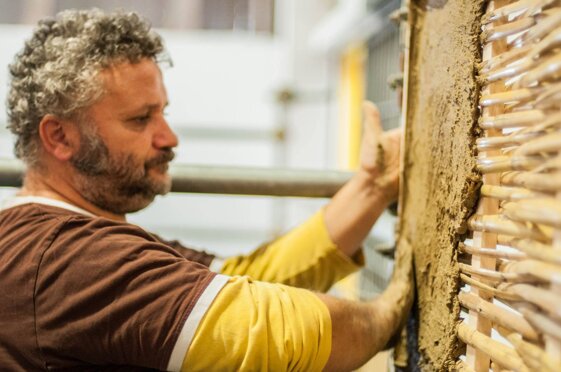
"At the end of the last century, I trained as an educator with Francesco Tonucci and soon after I built the Panta Rei center, under the guidance of Rainer Winter, and I directed it until 2013. In 2013, together with Sara and Andrea, we thought of setting up the construction company Terra e Paglia, with which we still build houses made with natural materials, wherever we are called. When needed, we support self-builders who, for various reasons, think they can build parts of their own house. Together with Sara, we continue to offer training and outreach activities to help spread unconventional construction that raises the sustainability of our living."
With the Patronage of
Municipality of Todi, Tiber River Park, La Consolazione ETAB

Where
Todi, Piazza del Popolo
HOW TO GET THERE
From the North (e.g. Florence, Bologna): Take the A1 motorway, exit at Valdichiana, follow the direction for Perugia on the E45 (SS675) and exit at Todi. From there, follow the signs for the historic center and parking areas.
From the South (e.g. Rome): Take the A1 motorway, exit at Orte, then follow the SS204 and E45 towards Perugia. Exit at Todi and follow the signs for the center.
Parking: The historic center of Todi is largely a ZTL (Limited Traffic Zone). You will need to park outside the walls. The most convenient parking lots are:
Ascensore Parking, in the Porta Orvietana area (paid, very spacious);
Consolazione Parking (free). From here you can reach the square on foot (about 15 minutes) or use the shuttle service.